

Le mot anglais du jour
well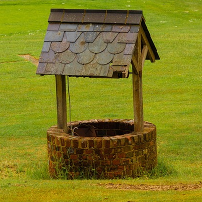
puits
Définitions
| anglais > français | |
| well | |
| 1. v. Bien. | |
| 2. n. Puits. | |
| 3. v. (Pour une émotion) Envahir. | |
| The water welled up. | |
| L'eau envahit/remplit l'endroit. | |
| 4. interj. S'emploie avant de répondre à une question pour remplir un vide de la conversation, « ben », « écoutez », « enfin. » | |
| 5. adj. (Pour la santé) Bonne. | |
| anglais > anglais | |
| well | |
| 1. adv. (manner) Accurately, competently, satisfactorily. |  |
| He does his job well. | |
| 2. adv. (manner) Completely, fully. | |
| a well done steak | |
| We’re well beat now. | |
| 3. adv. (degree) To a significant degree. | |
| That author is well known. | |
| 4. adv. (degree, British, slang) Very (as a general-purpose intensifier). | |
| 5. adv. In a desirable manner; so as one could wish; satisfactorily; favourably; advantageously. | |
| 6. adj. In good health. | |
| I had been sick, but now I'm well. | |
| 7. adj. (hypercorrect) Good, content. | |
| “How are you?” — “I'm well, thank you!” | |
| 8. adj. (archaic) Prudent; good; well-advised. | |
| 9. interj. Used to acknowledge a statement or situation. | |
| “The car is broken.” “Well, we could walk to the movies instead.” | |
| “I didn't like the music.” “Well, I thought it was good.” | |
| “I forgot to pack the tent! Well, I guess we're sleeping under the stars tonight.” | |
| 10. interj. An exclamation of surprise, often doubled or tripled. | |
| Well, well, well, what do we have here? | |
| 11. interj. An exclamation of indignance. | |
| Well! There was no need to say that in front of my mother! | |
| 12. interj. Used in speech to express the overcoming of reluctance to say something. | |
| It was a bit... well... too loud. | |
| 13. interj. Used in speech to fill gaps; filled pause. | |
| “So what have you been doing?” “Well, we went for a picnic, and then it started raining so we came home early.” | |
| 14. interj. (Hiberno-English) Used as a greeting | |
| Well lads. How's things? | |
| 15. n. A hole sunk into the ground as a source of water, oil, natural gas or other fluids. | |
| 16. n. A place where a liquid such as water surfaces naturally; a spring. | |
| 17. n. A small depression suitable for holding liquid or other objects. | |
| Make a well in the dough mixture and pour in the milk. | |
| 18. n. (figurative) A source of supply. | |
| 19. n. (nautical) A vertical, cylindrical trunk in a ship, reaching down to the lowest part of the hull, through which the bilge pumps operate. | |
| 20. n. (nautical) The cockpit of a sailboat. | |
| 21. n. (nautical) A compartment in the middle of the hold of a fishing vessel, made tight at the sides, but having holes perforated in the bottom to let in water to keep fish alive while they are transported | |
| 22. n. (nautical) A vertical passage in the stern into which an auxiliary screw propeller may be drawn up out of the water. | |
| 23. n. (military) A hole or excavation in the earth, in mining, from which run branches or galleries. | |
| 24. n. (architecture) An opening through the floors of a building, as for a staircase or an elevator; a wellhole. | |
| 25. n. The open space between the bench and the counsel tables in a courtroom. | |
| 26. n. (metalworking) The lower part of a furnace, into which the metal falls. | |
| 27. n. A well drink. | |
| They're having a special tonight: $1 wells. | |
| 28. n. (video games) The playfield of Tetris and similar video games, into which the blocks fall. | |
| 29. n. (biology) In a microtiter plate, each of the small equal circular or square sections which serve as test tubes. | |
| 30. v. (intransitive) To issue forth, as water from the earth; to flow; to spring. | |
| 31. v. (intransitive) To have something seep out of the surface. | |
| Her eyes welled with tears. | |
| français > anglais | |
| puits | |
| 1. n-m. well, shaft | |
Exemples de phrases
| It's said that she's a well-known actress. On dit qu'elle est une actrice renommée. Did everything go well? Est-ce que tout s'est bien passé ? You all did well. Vous avez tous bien réussi. I like English, but I cannot speak well. J'aime l'anglais, mais je ne peux pas bien le parler. I am not well at all. Je ne vais pas bien du tout. |
Revoir les mots précédents
| raspberry | boulder | root | frizzy |
| jellyfish | today | rainbow | Monday |
| bear | eighty-four | sixty-eight | teacher |
| fruit | car park | long | color |
Aléatoire
| badger | link | week | ceiling |
| handbrake | cloister | sieve | steel |
| furniture | thunder | small | forty-four |
| son | spinach | peach | lantern |
| Apprendre |
| Mot du jour |
| Choix multiple |
| Cartes flash |
| Loto |
| Image cachée |
| Jeu du pendu |
| Mots cachés |
| Memory |
| Mots croisés |
Procurez-vous notre livre de mots croisés pour débutants

| Abonnez-vous au mot du jour |
| Email: |