

Le mot anglais du jour
sea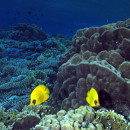
mer
Définitions
| anglais > français | |
| sea | |
| 1. n. Mer. | |
| 2. n. (Figuré) Mare. | |
| sea of blood, sea of money | |
| 3. n. Parage. | |
| The old sea captain was especially familiar with the treacherous seas long the coast. | |
| anglais > anglais | |
| sea | |
| 1. n. A large body of salt water. |  |
| 2. n. The ocean; the continuous body of salt water covering a majority of the Earth's surface. | |
| 3. n. A body of salt water smaller than an ocean, generally forming part of, or connecting with, an ocean or a larger sea. | |
| The Mediterranean Sea, the Caribbean Sea, the Sea of Crete, etc. | |
| 4. n. A lake, especially if large or if salty or brackish. | |
| The Caspian Sea, the Sea of Galilee, the Salton Sea, etc. | |
| 5. n. The swell of the sea; a single wave; billow. | |
| 6. n. (attributive, in combination) Living or used in or on the sea; of, near, or like the sea. | |
| Seaman, sea gauge, sea monster, sea horse, sea level, seaworthy, seaport, seaboard, etc. | |
| 7. n. (figurative) Anything resembling the vastness of the sea. | |
| 8. n. (planetology) A large, dark plain of rock; a mare. | |
| The Apollo 11 mission landed in the Sea of Tranquility. | |
| 9. n. (planetology) A very large lake of liquid hydrocarbon. | |
| français > anglais | |
| mer | |
| 1. n-f. sea (large body of water) | |
| 2. n-f. (used with the definite article) the ocean (the continuous body of salt water covering a majority of the Earth's surface) | |
Prononciation

Exemples de phrases
| The sun rose from the sea. Le soleil se leva sur la mer. I saw the ship sink in the sea. J'ai vu le navire sombrer en mer. The summit of the mountain is about 2000 meters above sea level. Le sommet de la montagne est de 2000 mètres au dessus du niveau de la mer. I like the mountains more than I like the sea. Je préfère la montagne à la mer. You must be careful when swimming in the sea. Sois prudent quand tu nages dans la mer. |
Revoir les mots précédents
| Netherlands | raspberry | boulder | root |
| frizzy | jellyfish | today | rainbow |
| Monday | bear | eighty-four | sixty-eight |
| teacher | fruit | car park | long |
Aléatoire
| clutch | island | peach | worm |
| lavender | horn | France | dart |
| chain | thirty-three | kettle | shower curtain |
| raspberry | tower | school desk | motor |
| Apprendre |
| Mot du jour |
| Choix multiple |
| Cartes flash |
| Loto |
| Image cachée |
| Jeu du pendu |
| Mots cachés |
| Memory |
| Mots croisés |
Procurez-vous notre livre de mots croisés pour débutants

| Abonnez-vous au mot du jour |
| Email: |