

Le mot anglais du jour
school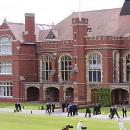
école
Définitions
| anglais > français | |
| school | |
| 1. n. École, endroit où on enseigne aux plus jeunes. | |
| 2. n. (États-Unis) Université. | |
| 3. n. Faculté, branche d'une université. | |
| School of Law | |
| 4. n. École composé des adhérents à une certaine doctrine. | |
| 5. n. Banc (groupe de poissons). | |
| A school of fish. | |
| Un banc de poissons | |
| 6. v. Éduquer, en particulier dans une école. | |
| anglais > anglais | |
| school | |
| 1. n. (collective) A group of fish or a group of marine mammals such as porpoises, dolphins, or whales. |  |
| The divers encountered a huge school of mackerel. | |
| 2. n. A multitude. | |
| 3. v. (lbl, en, intransitive) (of fish) To form into, or travel in a school. | |
| 4. n. (US, Canada) An institution dedicated to teaching and learning; an educational institution. | |
| Our children attend a public school in our neighborhood. | |
| Harvard University is a famous American postsecondary school. | |
| 5. n. (British) An educational institution providing primary and secondary education, prior to tertiary education (college or university). | |
| 6. n. (UK) At Eton College, a period or session of teaching. | |
| Divinity, history and geography are studied for two schools per week. | |
| 7. n. Within a larger educational institution, an organizational unit, such as a department or institute, which is dedicated to a specific subject area. | |
| We are enrolled in the same university, but I attend the School of Economics and my brother is in the School of Music. | |
| 8. n. An art movement, a community of artists. | |
| 9. n. (considered collectively) The followers of a particular doctrine; a particular way of thinking or particular doctrine; a school of thought. | |
| These economists belong to the monetarist school. | |
| 10. n. The time during which classes are attended or in session in an educational institution. | |
| I'll see you after school. | |
| 11. n. The room or hall in English universities where the examinations for degrees and honours are held. | |
| 12. n. The canons, precepts, or body of opinion or practice, sanctioned by the authority of a particular class or age. | |
| He was a gentleman of the old school. | |
| 13. n. An establishment offering specialized instruction, as for driving, cooking, typing, coding, etc. | |
| 14. v. To educate, teach, or train (often, but not necessarily, in a school.) | |
| Many future prime ministers were schooled in Eton. | |
| 15. v. To defeat emphatically, to teach an opponent a harsh lesson. | |
| 16. v. To control, or compose, one's expression. | |
| She took care to school her expression, not giving away any of her feelings. | |
| français > anglais | |
| école | |
| 1. n-f. school | |
Prononciation

Exemples de phrases
| I study hard at school. J'étudie très sérieusement à l'école. You can't learn here! This is a school! Tu ne peux pas apprendre ici ! C'est une école ! When I was in school, I really hated writing essays. Lorsque j'étais à l'école, j'avais vraiment horreur d'écrire des dissertations. My school is getting ready for the campus music festival. Mon école se prépare pour le festival de musique du campus. School being over, we went swimming in the pool. Comme l'école était terminée, nous sommes allés nager à la piscine. |
Revoir les mots précédents
| boulder | root | frizzy | jellyfish |
| today | rainbow | Monday | bear |
| eighty-four | sixty-eight | teacher | fruit |
| car park | long | color | old |
Aléatoire
| beetle | pen | plug | lizard |
| eighty-five | read | toothpaste | tap |
| car park | pianist | pillowcase | uncle |
| shorts | branch | gun | tea towel |
| Apprendre |
| Mot du jour |
| Choix multiple |
| Cartes flash |
| Loto |
| Image cachée |
| Jeu du pendu |
| Mots cachés |
| Memory |
| Mots croisés |
Procurez-vous notre livre de mots croisés pour débutants

| Abonnez-vous au mot du jour |
| Email: |