
Engels Woord van de dag
rabbit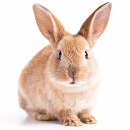
konijn
Definities
| Engels > Nederlands |
| rabbit |
| 1. konijn |
| Engels > Engels |
| rabbit |
| 1. n. A mammal of the family Leporidae, with long ears, long hind legs and a short, fluffy tail. |
| The pioneers survived by eating the small game they could get: rabbits, squirrels and occasionally a raccoon. |
| 2. n. The fur of a rabbit typically used to imitate another animal's fur. |
| 3. n. A runner in a distance race whose goal is mainly to set the pace, either to tire a specific rival so that a teammate can win or to help another break a record; a pacesetter. |
| 4. n. (cricket) A very poor batsman; selected as a bowler or wicket-keeper. |
| 5. n. (comptheory) A large element at the beginning of a list of items to be bubble sorted, and thus tending to be quickly swapped into its correct position. Compare turtle. |
| 6. v. (intransitive) To hunt rabbits. |
| 7. v. (US, intransitive) To flee. |
| The informant seemed skittish, as if he was about to rabbit. |
| 8. v. (UK, intransitive) To talk incessantly and in a childish manner; to babble annoyingly. |
| Stop your infernal rabbiting! Use proper words or nobody will listen to you! |
| Commonly used in the form "to rabbit on". |
| Nederlands > Engels |
| konijn |
| 1. n-n. A rabbit, a bunny; any non-hare lagomorph of the family Leporidae. |
Uitspraak

Voorbeeldzinnen
| When will she stop looking like a rabbit? They're home doing their rabbit imitation. Now the white rabbit pops up again to say that it will make the knaves have bigger, clearer labels. We squelched our way off the site, startled this time by a rabbit leaping from cover. I squeaked, in a passable impression of a startled rabbit. |
Vorige woorden herzien
| long | mirror | handbag | school desk |
| eighteen | red | hour | beer |
| living room | blink | small | pear |
| syringe | cymbal | underwear | seventy-nine |
Willekeurig
| Leer |
| Woord van de dag |
| Meerkeuzevraag |
| Flashkaarten |
| Bingo |
| Verborgen afbeelding |
| Galgje |
| Woordzoeker |
| Geheugen |
| Kruiswoordpuzzel |
| Abonneer u op Woord van de Dag |
| E-mail: |