| Engels > Nederlands |
|
| field |
| 1. veld |
| Engels > Engels |
|
| field |
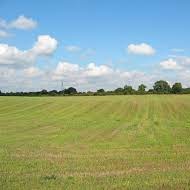
| 1. n. A land area free of woodland, cities, and towns; open country. |
| There are several species of wild flowers growing in this field. |
| 2. n. (usually plural) The open country near or belonging to a town or city. |
| 3. n. # An airfield, airport or air base; especially, one with unpaved runways. |
| 4. n. A wide, open space that is usually used to grow crops or to hold farm animals. |
| There were some cows grazing in a field. |
| A crop circle was made in a corn field. |
| 5. n. (geology) A region containing a particular mineral. |
| oil field; gold field |
| 6. n. A place where competitive matches are carried out. |
| 7. n. A place where a battle is fought; a battlefield. |
| 8. n. An area reserved for playing a game or race with one’s physical force. |
| soccer field |
| Substitutes are only allowed onto the field after their boots are checked. |
| 9. n. # (baseball, obsolete) The team in a match that throws the ball and tries to catch it when it is hit by the other team (the bat). |
| 10. n. # (baseball) The outfield. |
| 11. n. A place where competitive matches are carried out with figures, playing field, in a boardgame or in a computer game. |
| 12. n. A competitive situation, circumstances in which one faces conflicting moves of rivals. |
| 13. n. (metonymically) All of the competitors in any outdoor contest or trial, or all except the favourites in the betting. |
| This racehorse is the strongest in a weak field. |
| 14. n. Any of various figurative meanings, regularly dead metaphors. |
| 15. n. (physics) A physical phenomenon (such as force, potential or fluid velocity) that pervades a region; a mathematical model of such a phenomenon that ass |
| magnetic field; gravitational field; scalar field |
| 16. n. (Any of certain structures serving cognition.) |
| 17. n. # The extent of a given perception. |
| # field of view |
| 18. n. # A realm of practical, direct or natural operation, contrasted with an office, classroom, or laboratory. |
| # The design needs to be field-tested before we commit to manufacture. |
| # Field work traditionally distinguishes true archaeologists from armchair archaeologists. |
| # He needs some time in the field before his judgment can be trusted. |
| 19. n. # A domain of study, knowledge or practice. |
| # He was an expert in the field of Chinese history. |
| 20. n. # An unrestricted or favourable opportunity for action, operation, or achievement. |
| 21. n. # (algebra) A commutative ring satisfying the field axioms. |
| # The set of rational numbers,\mathbbQ, is the prototypical field. |
| 22. n. A physical or virtual location for the input of information in the form of symbols. |
| 23. n. # (heraldry) The background of the shield. |
| 24. n. # (vexillology) The background of the flag. |
| 25. n. # A concrete section in a form which is supposed to be filled with data. |
| # The form has fields for each element of the customer's home address and ship-to address. |
| 26. n. # A component of a database in which a single unit of information is stored. |
| 27. n. ## (computing) An area of memory or storage reserved for a particular value, subject to virtual access controls. |
| 28. v. (transitive, sports) To intercept or catch (a ball) and play it. |
| 29. v. (baseball, softball, cricket, and other batting sports) To be the team catching and throwing the ball, as opposed to hitting it. |
| The blue team are fielding first, while the reds are batting. |
| 30. v. (transitive, sports) To place a team in (a game). |
| The away team fielded two new players and the second-choice goalkeeper. |
| 31. v. To answer; to address. |
| She will field questions immediately after her presentation. |
| 32. v. To defeat. |
| They fielded a fearsome army. |
| 33. v. To execute research (in the field). |
| He fielded the marketing survey about the upcoming product. |
| 34. v. (transitive, military) To deploy in the field. |
| Nederlands > Engels |
|
| veld |
| 1. n-n. field, open country |
| 2. n-n. an agricultural field |
| De boer plantte tarwe in zijn uitgestrekte velden. - The farmer planted wheat in his extensive fields. |
| 3. n-n. a patch or grass and/or other small plants |
| De kinderen renden en speelden in het groene veldje naast het huis. - The children ran and played in the green patch next to the house. |
| 4. n-n. field (geographical theatre where warriors operate, especially in battle) |
| De generaal leidde zijn troepen naar het slagveld. - The general led his troops to the battlefield. |
| 5. n-n. a sports field |
| We speelden voetbal op het grote veld achter de school. - We played soccer on the large field behind the school. |
| De atleten trainen hard op het atletiekveld voor de aankomende wedstrijd. - The athletes are training hard on the athletics field for the upcoming competition. |
| 6. n-n. a subject field, domain of knowledge, in particular an academic field |
| Het onderzoek valt binnen het wetenschappelijke veld van de psychologie. - The research falls within the scientific field of psychology. |
| 7. n-n. (physics) a field (physical phenomenon pervading an area) |
| Elektrische ladingen oefenen krachten uit op elkaar via het elektrostatisch veld dat hen omringt. - Electric charges exert forces on each other through the electrostatic field that surrounds th |