| Englisch > Deutsch | |
|
| spit | |
| 1. Substantiv: | |
| 2. [1] dünner, spitzer Metallstab, auf den man Fleisch zum Braten oder Kochen aufspießt; Bratspieß | |
| [1] „In the cuisine of Northern Africa, Méchoui is a whole sheep or a lamb spit roasted on a barbecue.“ | |
| In der nordafrikanischen Küche ist Méchoui ein ganzes Schaf oder Lamm am Spieß, das auf einem Grill geröstet wird. | |
| 3. Substantiv: | |
| 4. [1] umgangssprachlich: im Mund befindliche Flüssigkeit; Sekret der Speicheldrüsen; Spucke | |
| [1] In china it can happen easily to get some spit on your shoes. | |
| In China kann es schnell passieren, etwas Spucke auf den Schuh zu bekommen. | |
| 5. Substantiv: | |
| 6. [1] Nehrung, Landzunge | |
| [1] „The Curonian Spit.“ | |
| Die Kurische Nehrung. | |
| Englisch > Englisch | |
|
| spit | |
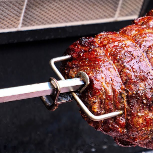
| 1. subst. A rod on which meat is grilled (UK English) or broiled (US English). |  |
| 2. subst. A narrow, pointed, usually sandy peninsula. | |
| 3. subst. The depth to which a spade goes in digging; a spade; a spadeful. | |
| 4. v. To impale on a spit. | |
| to spit a loin of veal | |
| 5. v. To attend to a spit; to use a spit. | |
| She's spitting in the kitchen. | |
| 6. v. To spade; to dig. | |
| 7. v. (intransitive, transitive) To evacuate (saliva or another substance) from the mouth, etc. | |
| a hot pan spitting droplets of fat | |
| 8. v. To rain or snow slightly, or with sprinkles. | |
| 9. v. To utter violently. | |
| 10. v. (transitive, slang) To rap, utter. | |
| 11. subst. Saliva, especially when expectorated. | |
| There was spit all over the washbasin. | |
| 12. subst. An instance of spitting. | |
| Deutsch > Englisch | |
|
| Spieß | |
| 1. n-m. a pointed rod, especially | |
| 2. n-m. spit | |
| (hyponyms, Bratspieß, Drehspieß, Fleischspieß) | |
| Heute Abend grillen wir Krabben am Spieß. - Tonight we’ll grill crabs on the spit. | |
| 3. n-m. pike | |
| (hyponyms, Langspieß, Pike, Saufeder, Wurfspieß) | |
| Er griff sich einen Zaunpfahl und verwendete ihn als Spieß. - He grabbed himself a fence post and used it as a pike. | |
| 4. n-m. * Luther Bible, Jesaja 2:4 | |
| 5. n-m. *: (quote, Da werden sie ihre Schwerter zu Pflugscharen und ihre Spieße zu Sicheln machen., and they shall beat their swords into plowshares, and their | |
| 6. n-m. (chess, figuratively) skewer (tactic in the game of chess) | |
| Durch einen Spieß setzte er den gegnerischen König ins Schach. - With a skewer he put the opponent’s king in check. | |
| 7. n-m. (Germany, military) an appointment usually held by a Stabsfeldwebel or Oberstabsfeldwebel (OR-8/9), roughly equivalent to company sergeant major in the British Army and comparable to first sergeant in | |
| (hyponyms, Batteriefeldwebel, q1=artillery, air defense, Inspektionsfeldwebel, q2=schools, Staffelfeldwebel, q3=flying personnel, Wachtmeister, q4=marine) | |
| Der Spieß ist Unteroffizier in einer Kompanie auf einem herausgehobenen Dienstposten. - The Spieß is non-commissioned officer in a company in an important post. | |


 ©
©