| Englisch > Deutsch | |
|
| sieve | |
| 1. Verb: | |
| 2. [1] unerwünschte Elemente aus einem Material mit einem Sieb entfernen | |
| Englisch > Englisch | |
|
| sieve | |
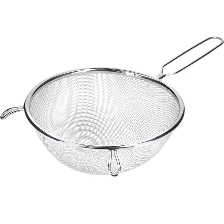
| 1. subst. A device with a mesh bottom to separate, in a granular material, larger particles from smaller ones, or to separate solid objects from a liquid. |  |
| Use the sieve to get the pasta from the water. | |
| 2. subst. A process, physical or abstract, that arrives at a final result by filtering out unwanted pieces of input from a larger starting set of input. | |
| Given a list of consecutive numbers starting at 1, the Sieve of Eratosthenes algorithm will find all of the prime numbers. | |
| 3. subst. (obsolete) A kind of coarse basket. | |
| 4. subst. (colloquial) A person, or their mind, that cannot remember things or is unable to keep secrets. | |
| 5. subst. (category theory) A collection of morphisms in a category whose codomain is a certain fixed object of that category, which collection is closed under pre-composition by any morphism in the category. | |
| 6. v. To strain, sift or sort using a sieve. | |
| 7. v. (sports) To concede; let in | |
| Deutsch > Englisch | |
|
| Sieb | |
| 1. subst. sieve; sifter; strainer; colander; riddle (any device with holes used to separate solids from liquids or fine matter from coarse matter) | |
| Wie kann man Wasser in einem Sieb tragen? - How can you carry water in a sieve? | |


 ©
©