| Engelsk > Engelsk |
|
| spring |
| 1. v. To jump or leap. |
| He sprang up from his seat. |
| 2. v. To pass over by leaping. |
| to spring over a fence (in this sense, the verb spring must be accompanied by the preposition 'over'.) |
| 3. v. To produce or disclose unexpectedly, especially of surprises, traps, etc. |
| 4. v. (slang) To release or set free, especially from prison. |
| 5. v. (Australia, slang) To suddenly catch someone doing something illegal or against the rules. |
| 6. v. To come into being, often quickly or sharply. |
| Trees are already springing up in the plantation. |
| 7. v. To start or rise suddenly, as from a covert. |
| 8. v. To cause to spring up; to start or rouse, as game; to cause to rise from the earth, or from a covert. |
| to spring a pheasant |
| 9. v. (nautical) To crack or split; to bend or strain so as to weaken. |
| to spring a mast or a yard |
| 10. v. To bend by force, as something stiff or strong; to force or put by bending, as a beam into its sockets, and allowing it to straighten when in place; often with in, out, etc. |
| to spring in a slat or a bar |
| 11. v. To issue with speed and violence; to move with activity; to dart; to shoot. |
| 12. v. To move suddenly when pressure is released. |
| A bow, when bent, springs back by its elastic power. |
| 13. v. (intransitive) To bend from a straight direction or plane surface; to become warped. |
| A piece of timber, or a plank, sometimes springs in seasoning. |
| 14. v. To shoot up, out, or forth; to come to the light; to begin to appear; to emerge, like a plant from its seed, a stream from its source, etc.; often followed by up, forth, or out. |
| 15. v. To issue or proceed, as from a parent or ancestor; to result, as from a cause, motive, reason, or principle. |
| 16. v. (obsolete) To grow; to prosper. |
| 17. v. (architecture, masonry, transitive) To build (an arch). |
| They sprung an arch over the lintel. |
| 18. v. (transitive, archaic) To sound (a rattle, such as a watchman's rattle). |
| 19. n. A leap; a bound; a jump. |
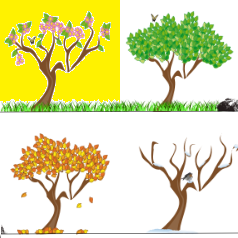
| 20. n. Traditionally the first of the four seasons of the year in temperate regions, in which plants spring from the ground and trees come into blossom, following winter and preceding summer. |
| Spring is the time of the year most species reproduce. |
| I spent my spring holidays in Morocco. |
| You can visit me in the spring, when the weather is bearable. |
| 21. n. Meteorologically, the months of March, April and May in the northern hemisphere or September, October and November in the southern. |
| 22. n. The astronomically delineated period from the moment of vernal equinox, approximately March 21 in the northern hemisphere to the moment of the summer solstice, approximately June 21. (See (pedialite |
| 23. n. Spring tide; a tide of greater-than-average range, that is, around the first or third quarter of a lunar month, or around the times of the new or full moon. |
| 24. n. A place where water or oil emerges from the ground. |
| This water is bottled from the spring of the river. |
| 25. n. The property of a body of springing to its original form after being compressed, stretched, etc. |
| the spring of a bow |
| 26. n. Elastic power or force. |
| 27. n. A mechanical device made of flexible or coiled material that exerts force when it is bent, compressed or stretched. |
| We jumped so hard the bed springs broke. |
| 28. n. (slang) An erection of the penis. |
| 29. n. The source of an action or of a supply. |
| 30. n. Any active power; that by which action, or motion, is produced or propagated; cause; origin; motive. |
| 31. n. That which springs, or is originated, from a source. |
| 32. n. A race; lineage. |
| 33. n. A youth; a springald. |
| 34. n. A shoot; a plant; a young tree; also, a grove of trees; woodland. |
| 35. n. (obsolete) That which causes one to spring; specifically, a lively tune. |
| 36. n. The time of growth and progress; early portion; first stage. |
| 37. n. (nautical) A rope attaching the bow of a vessel to the stern-side of the jetty, or vice versa, to stop the vessel from surging. |
| You should put a couple of springs onto the jetty to stop the boat moving so much. |
| 38. n. (nautical) A line led from a vessel's quarter to her cable so that by tightening or slacking it she can be made to lie in any desired position; a line led diagonally from the bow or stern of a vessel |
| 39. n. (nautical) A crack or fissure in a mast or yard, running obliquely or transversely. |
| Svenska > Engelsk |
|
| vår |
| 1. pron. our; belonging to us |
| 2. n-c. spring; the season between winter and summer |

 ©
©